In Conversation with Andrej Dúbravský
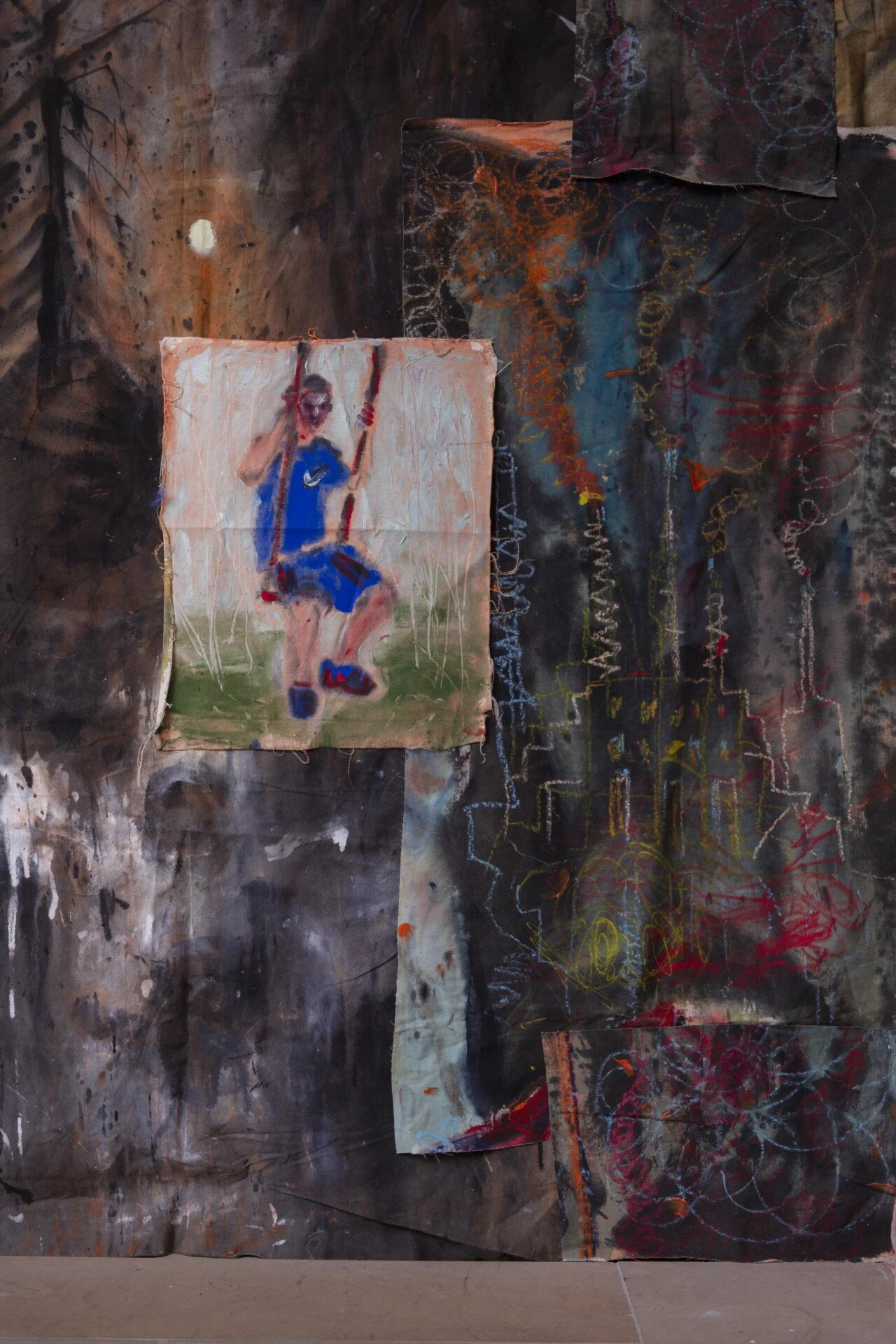
Andrej Dúbravský, installation view of Protest of Peculiars at Kunstpalais, Erlangen, November 29, 2025–February 22, 2026. Photo courtesy of the artist.
Earlier this year, Clara Simak, director of the Painting Diary Residency, and I boarded a bus from Vienna to visit Andrej Dúbravský in a small village near Bratislava, Slovakia. Our journey between Europe’s closest capital cities, though only a little over an hour, felt more like a passage between two entirely different worlds. At Dúbravský’s studio, life-sized works of Fragonardesque bodies and self-portraits engulfed us as we found ourselves totally absorbed by conversation, and delightfully lingering much longer than intended. As seems natural with extremely fun studio visits in countries you’ve never visited before, Clara and I missed our bus back to Austria’s capital… though only one of us really minded.
With many of Dúbravsky’s paintings already sent to Kunstpalais Erlangen in Germany for a solo show, the works and sketches that remained scattered across the studio occupied a state of uncertainty—a productive kind of limbo. Large canvases leaned against walls beside scraps of multi-colored and patterned bed sheets depicting precious fragments of ecological life. Some of these had been pinned to the studio wall, as if waiting for a light-bulb moment of resolution, while others seemed destined for total metamorphosis. It was almost immediately clear that Dúbravský was less concerned with completion than with the cycles naturally unfolding around him.
A cast of flowers, insects, athletes, lovers, and young men distinguishes Dúbravský’s paintings through persistent recurrence. These signature yet varied motifs cycle across decades, dissolving into washes of paint before resurfacing as altered embodiments of themselves. Unstretched canvases migrate between exhibition installations and studio walls, while the pollinators populating his paintings mirror Dúbravský’s repeated observations from life, as they arrive before returning to his very own magical garden.
Throughout our conversation, Dúbravský reflected on painting as a form of field research, the relationship between eroticism and visibility, insects as models of resistance, institutional reception in Slovakia, and the new peculiarities he’s discovered from returning to familiar imagery over and over again.
—Clare Gemima, August 2026
Clare Gemima: When I visited your studio in Bratislava earlier this year, it was essentially post-operational as a lot of your work had already been sent to Erlangen, Germany, for your show, Protest of Peculiars, which ran at the Kunstpalais there from November 29, 2025 to February 22, 2026. During these interim periods, after works have headed out to be exhibited, how do you operate in the studio? Do you find yourself reworking earlier paintings, starting new ones, or moving between both, and how do those decisions shape how interconnected your bodies of work become?
Andrej Dúbravský: I was actually pretty sad that you came to my studio in such an unfortunate period, because I felt like there was nothing good to show you. As you mentioned, everything that was finished was hanging in my show at Kunstpalais Erlangen already. A couple of weeks after I saw you, I started working on paintings for my current exhibition, The Rest Interval, which opened on May 5 at Villa Pelle in Prague, so while you were here, what you could see in the studio was insight into the process of me creating future exhibitions—basically an aftermath of me going through piles of canvases trying to decide what should either be completely destroyed, or worth saving in some kind of ridiculous attempt to redeem it, for better or worse. Honestly, transforming something that’s been rotting in my studio for a few months into a masterpiece rarely happens, but these canvas scraps gave me a chance to experiment and test ideas that I could later carry into other paintings. At times I will cut smaller pieces of canvas from larger compositions and nail it to the studio wall so I can use it like a Post-it note if I like its structure or colour combination.
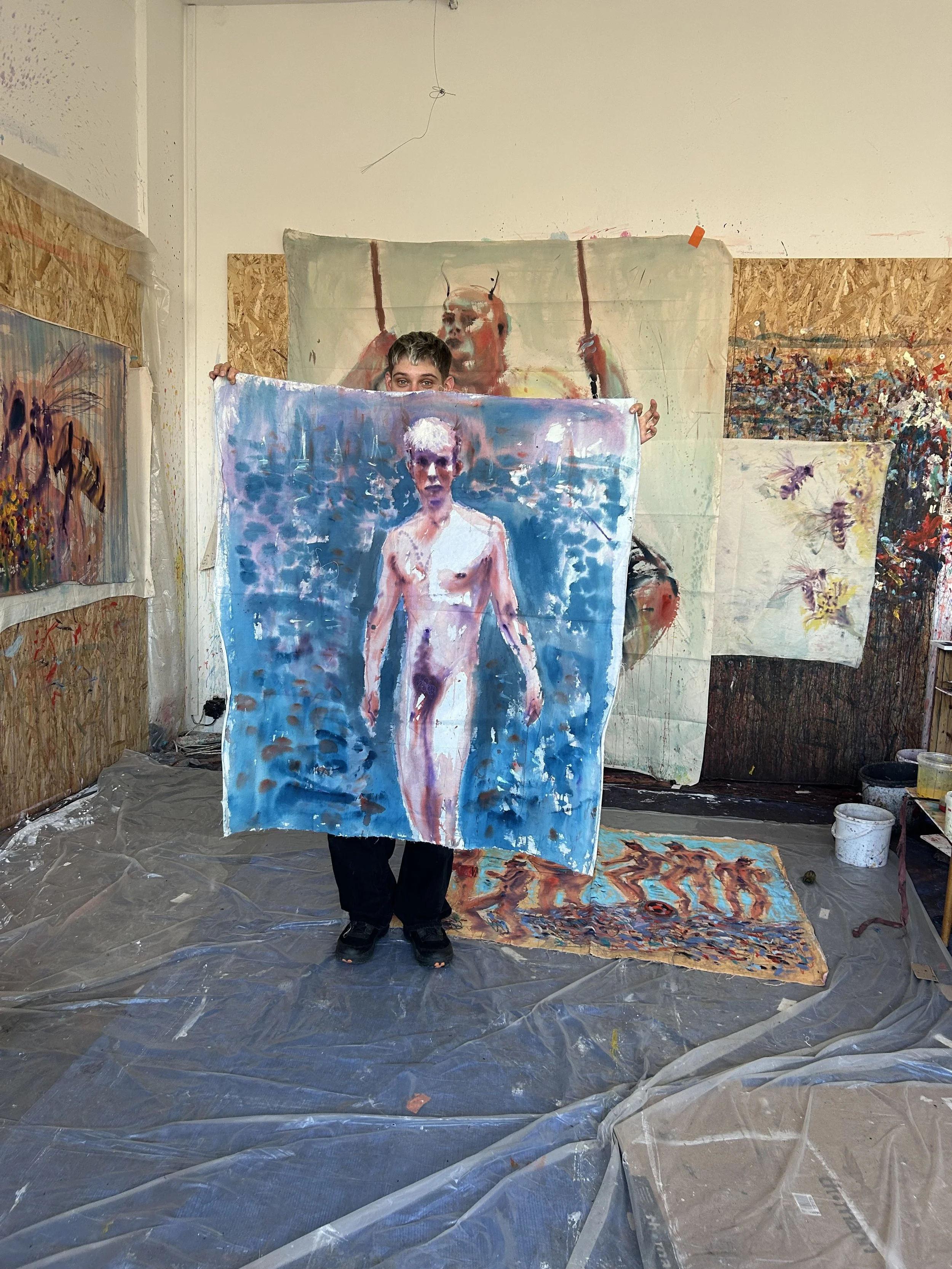
Visit to Andrej Dúbravský’s studio in Bratislava, Slovakia, January 2026. Photo courtesy of Painting Diary.
CG: Working from Slovakia, your imagery—sensual, explicit, and often depicting figures rendered entirely nude—is rooted in a kind of domestic homosexual intimacy, yet circulates within the country’s relatively conservative cultural framework, especially in contrast to places like New York or Berlin. How has local reception shaped what you allow yourself to exhibit or withhold?
AD: I like that you didn’t ask me if the reception in Slovakia has shaped what I allow myself to paint, because it’s just not the case. I paint whatever makes sense to me in the moment no matter where I am—a studio in New York, where people usually don’t care much about the nature of my works, or from my village house. With exhibitions here though, I am kind of careful because I don’t want to fulfil the expectation (which is especially prominent here in Slovakia) of me being a controversial “sexy, gay painter.” The more some people talk about me this way (like the Minister of Culture, for example), the more I want to show paintings of bees on flowers, make books for kids about insects like Alica a hmyz (2026), which came out on May 28, facilitate workshops with seniors, and ultimately exhibit the cutest, least controversial paintings of mine. I have to say, I enjoy the kind of dissonance my audience here must experience, and I am trying to work with it as purposefully as possible.
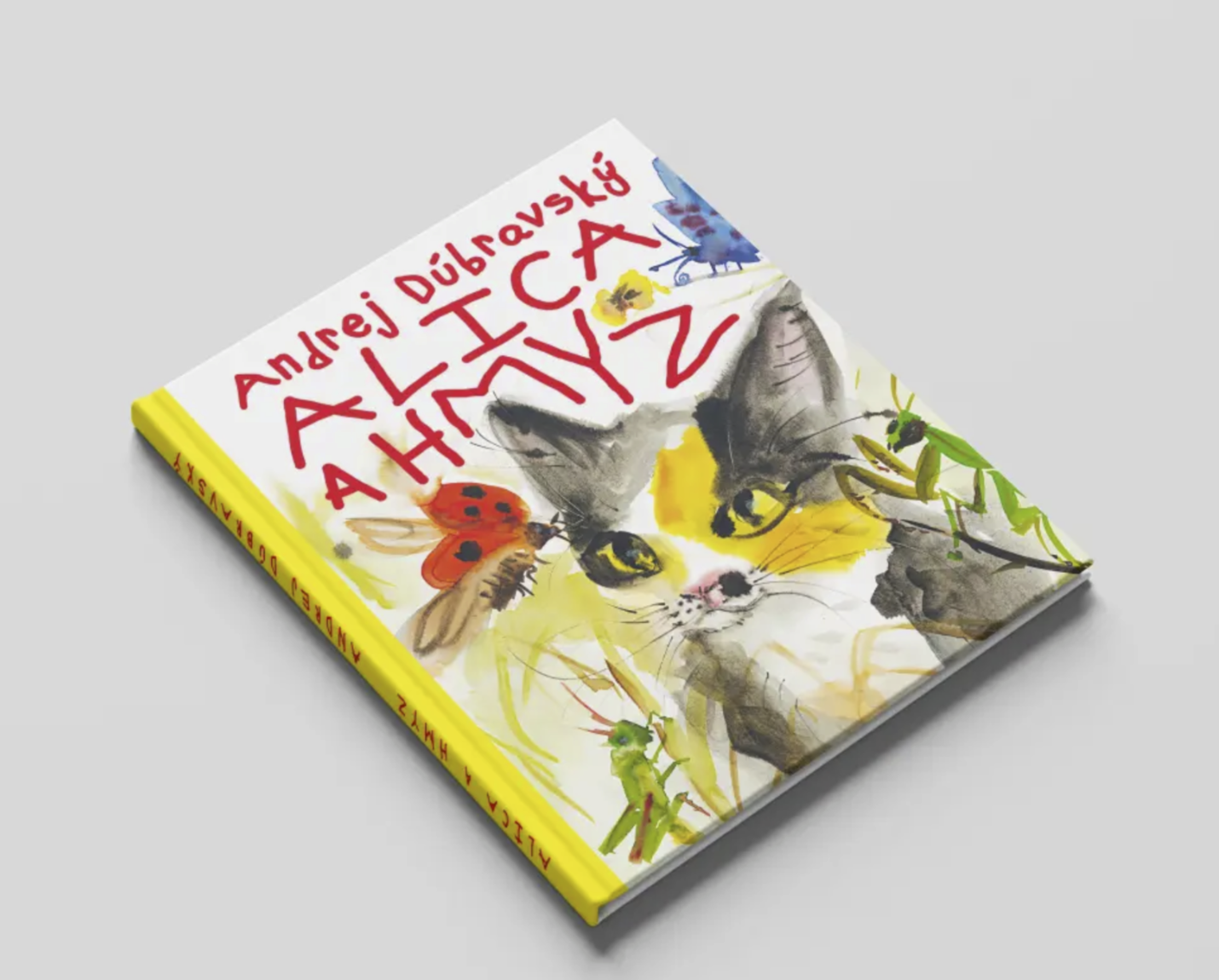
Andrej Dúbravský, Alica a hmyz, 2026. Photo courtesy of the artist.
CG: After visiting your studio, Clara and I went to see your work in the group exhibition Smoke and Mirrors at the Bratislava City Museum. I was curious whether this, and other institutional settings, recalibrate the way your paintings are framed or received. Does placing work within a museum setting neutralize your painting’s erotic or disruptive charge, or intensify it through contrast? And were there any implicit or explicit negotiations around what could be shown in that space?
AD: Thank God this particular museum is very free and open. There was absolutely no censorship—not even the unspoken or subtle kind which, in my opinion, is the worst type. Censorship that you’re only made aware of through tiny hints from the curator is awful. I think this particular museum has a firm position and wants to strongly oppose the National Gallery, which is now totally censored. In 2015, I was probably the youngest artist to ever open a solo show at the National Gallery, and I remember showing really explicit paintings. One was even called Aanal Ikebana, 2015, and nobody said a word. This only happened because it was a wildly different time. Nobody used art as a tool to polarise society on social media, as an example.
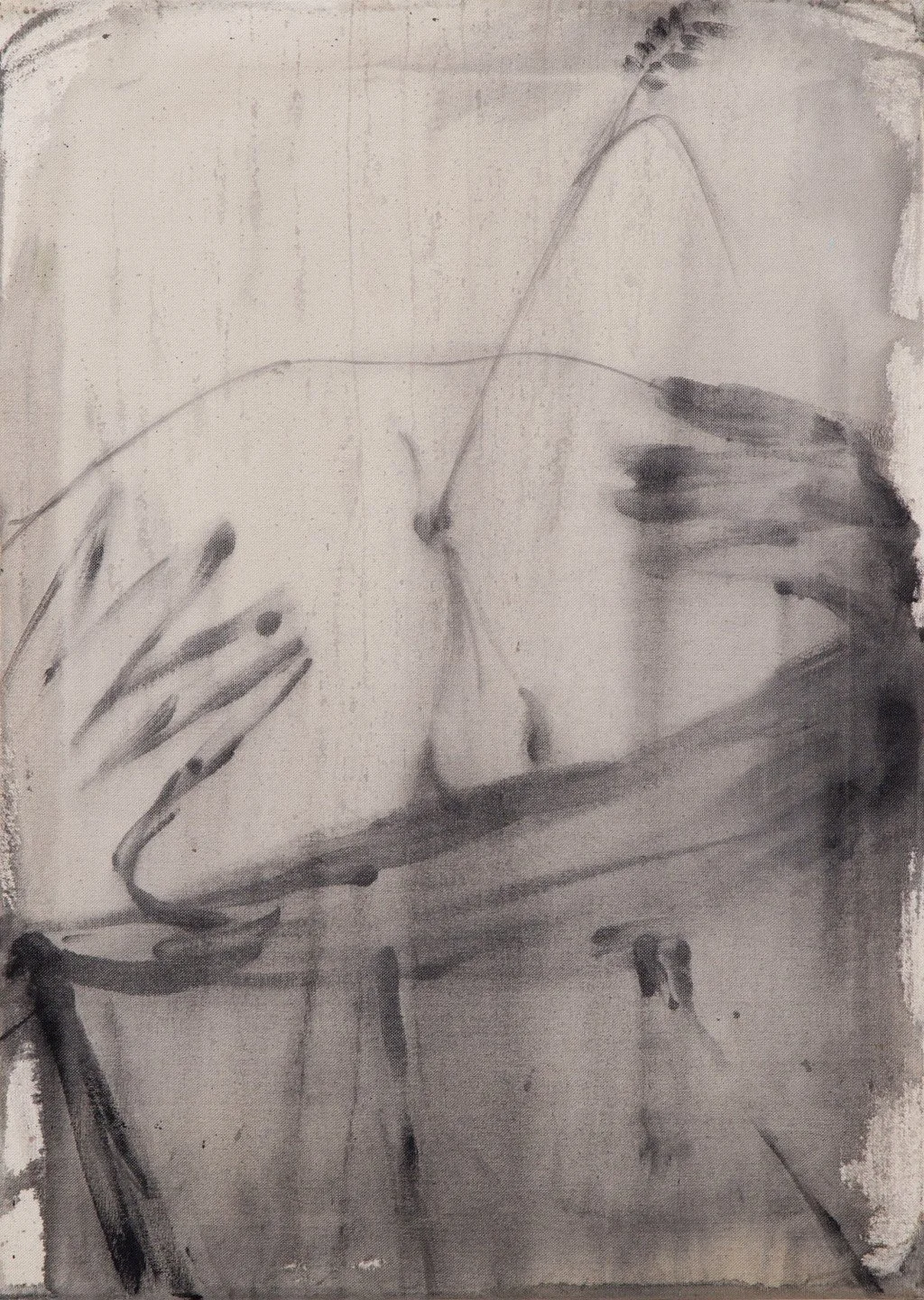
Andrej Dúbravský, Anal ikebana (spread), 2015. Acrylic on canvas, 70 × 50 cm. Photo courtesy of the artist.
CG: Your paintings often depict moments of desire, intimacy, and sexual awakening through figures suspended within lush natural environments. They have been described as both charged and atmospheric, offering a kind of vague arousal while circling the male body as a site of sexual awakening and identity. You yourself have described painting “Dystopic Twinks”—characters that move between registers of tenderness and something closer to exploitative or even pornographic. In a compelling way, the figures you paint never fully stabilize—they range in age, the curvatures of their bodies, and their sensibility on the canvas. At times you have depicted them in more peaceful and intimate poses, in a cuddly snooze, while others slide toward more fantastical arenas like the Schiele-esque duo in Frogs Mating, Always in Total Chaos, but at Least Quickly, 2024. Where does your portraiture originate—are these figures observed, remembered, or constructed?
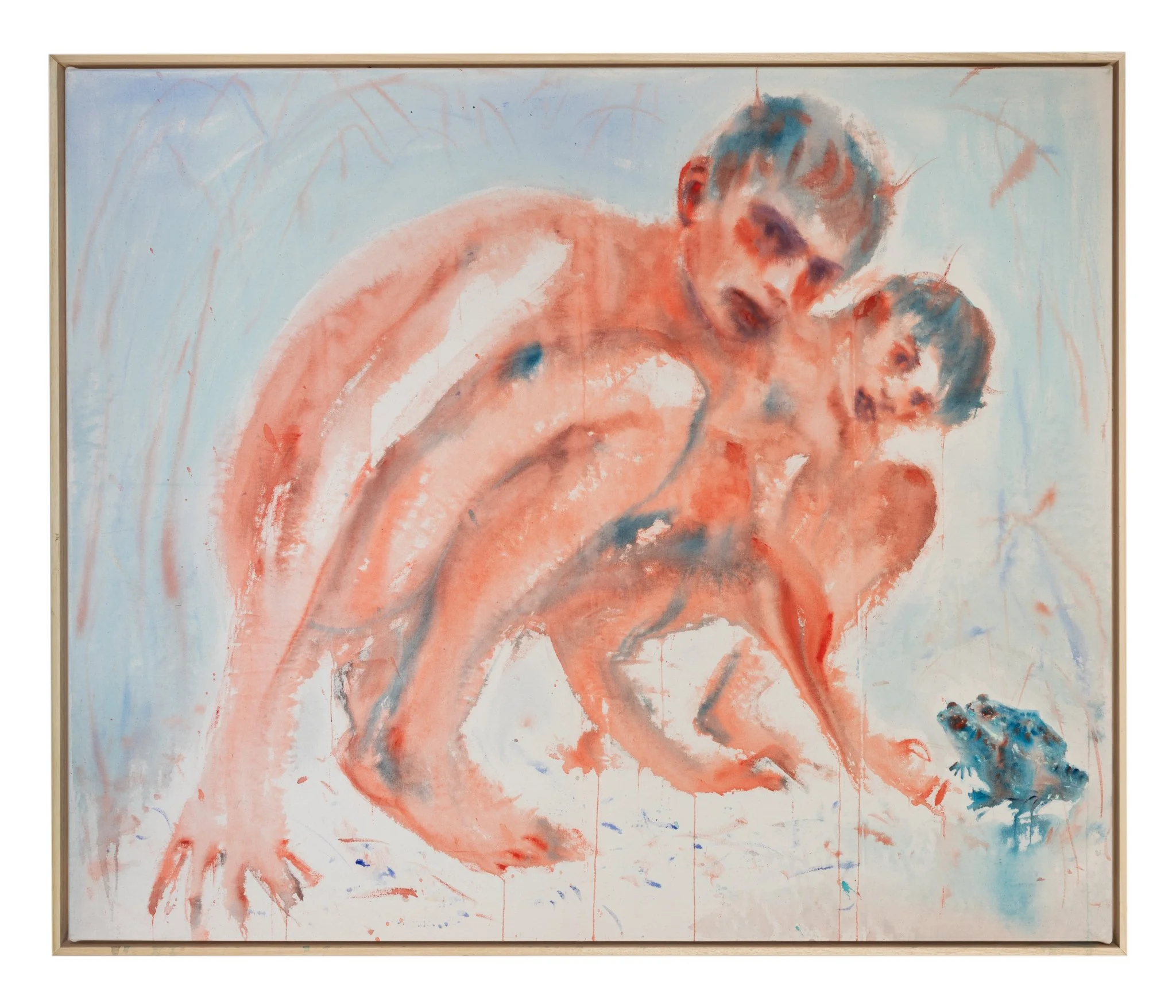
Andrej Dúbravský, Frogs Mating, Always in Total Chaos, but at Least Quickly, 2024. Acrylic and oil pastel on canvas, 100 × 120 cm. Photo courtesy of the artist.
AD: The human body is the thing that has excited me the most since starting to draw as a kid and discovering the history of art. Basically, I didn’t care about anything else—just living bodies, flesh tones and shades of skin, and movement. Yes, porn is a place where you can see a lot of bodies, some that sport absolutely incredible facial expressions, or pimples on their butts. I think porn is a great resource for painters, but I tend to lean on screenshots of Instagram posts more often. I used to love Tumblr, which was a really great source before it was completely censored, but I am also looking at paintings of old masters to see how they depict the body, specifically in the way they created faces and skin. It really doesn’t matter if inspiration for poses derive from sacral painting or porn. At my show in Prague, I presented paintings of bodies which are falling upside down that echo a work by Rubens, and in another, a body hangs from a tree branch which makes reference to The Martyrdom of Saint Philip, 1639, by Jusepe de Ribera.
CG: Protest of Peculiars presented a fragile ecosystem—bees, caterpillars, flowers, frogs—alongside nudes, from heads to full bodies, and smeared berry clusters that verged on the scrotal. Installed in an arbitrary, salon-style arrangement, with stretched canvases mounted atop unstretched ones, a sense of secrecy ran through the installation—faintly cheeky and distinctly naughty—as though the walls themselves had developed a private language. The figures appeared to converse across surfaces, exchanging glances and coded messages that remained inaccessible to viewers, yet nonetheless retained an undeniable charm.
The term “protest” in the show’s title suggests a kind of taxonomy of peculiar creatures. Worm-like forms slip into slimy phalluses, and spikey bugs soften into slinky slugs. Between each framed piece, the installation’s ink-stained and blotted backdrop absorbed and reformed any natural mistake that occurred in its making. How do you see the relationship between insect systems and human behavior—particularly in regards to sexuality and evolution? Do they bleed into each other, or is there a natural resistance?
AD: When it comes to my garden, my main priority is to create a big oasis for pollinators where wild bees and other animals can find as much food as possible. The surrounding village is a vast agricultural landscape, a so-called “agro desert” full of endless fields where insects can find almost no food at all. I sit in the garden to eat almost every meal, as I observe pollinators flying from flower to flower. It makes me think a lot about plants; for example, how they experience pollination, which is essentially sex for them. It’s also one of the reasons I paint pollen differently… way thicker than anything else. There are so many diverse versions of partnership and lovemaking in the animal and plant world that provide an endless amount of inspiration for me. Some bees live in big colonies, while others are completely solitary and happy about it. There are very few species of insects which live in pairs and take care of their kids together, like burying beetles, for example. I love organisms that in my eyes exist in protest just by the mere fact they can survive nowadays, no matter how polluted the world is right now. They are still here, resilient as they continue doing their simple job. I feel pretty similar. I can simplify it totally—it doesn’t matter what’s happening in the government(s), social media, or the distant “art world.” I just come to the studio every day and work on my paintings until I can’t anymore. That’s my protest. I sometimes feel like a bee collecting pollen from random weeds or tiny pieces of grass in the middle of a busy crossroad in some massive metropolis.
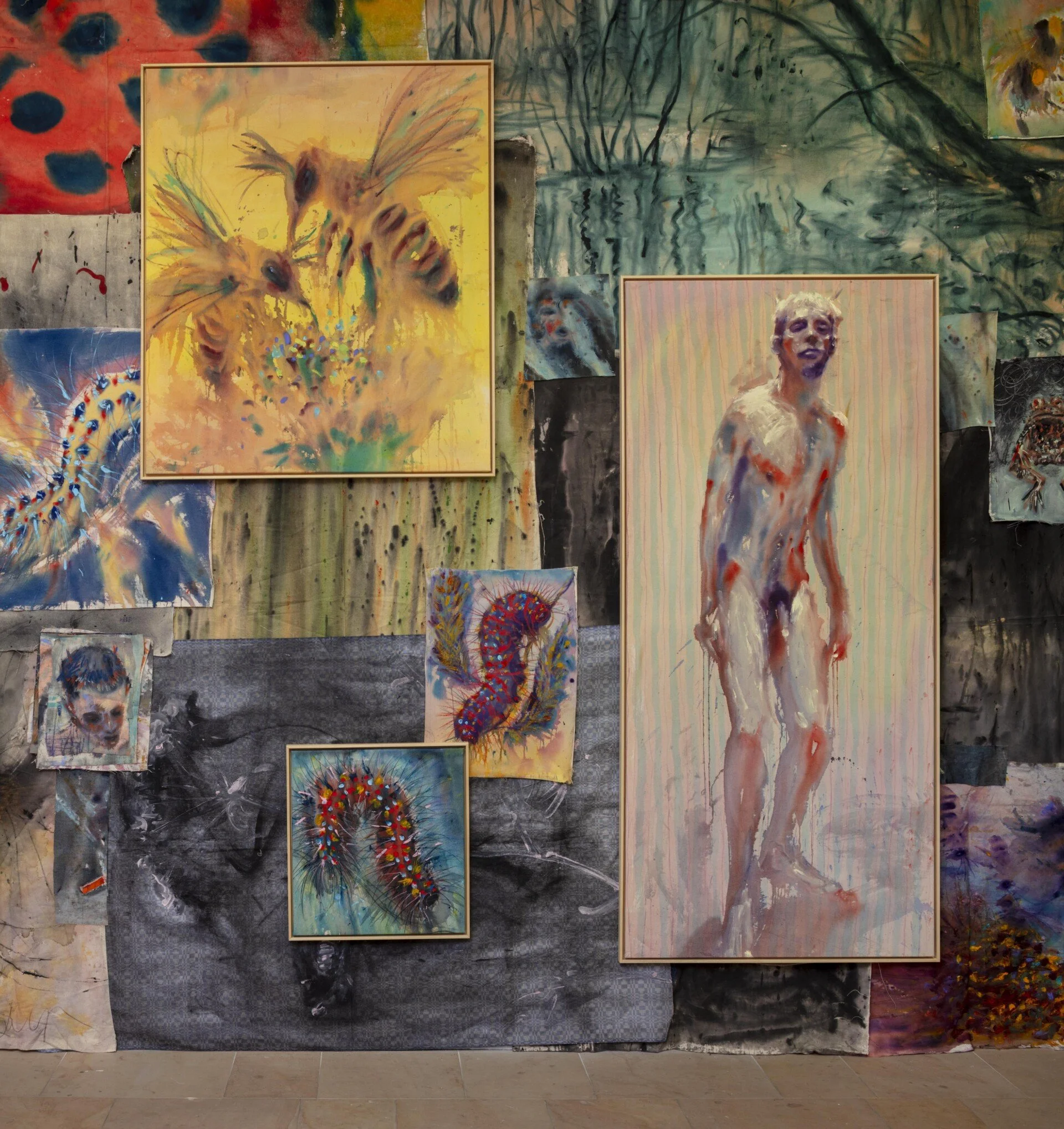
Andrej Dúbravský, installation view of Protest of Peculiars at Kunstpalais, Erlangen, November 29, 2025–February 22, 2026. Photo courtesy of the artist.
“I just come to the studio every day and work on my paintings until I can’t anymore. That’s my protest.”
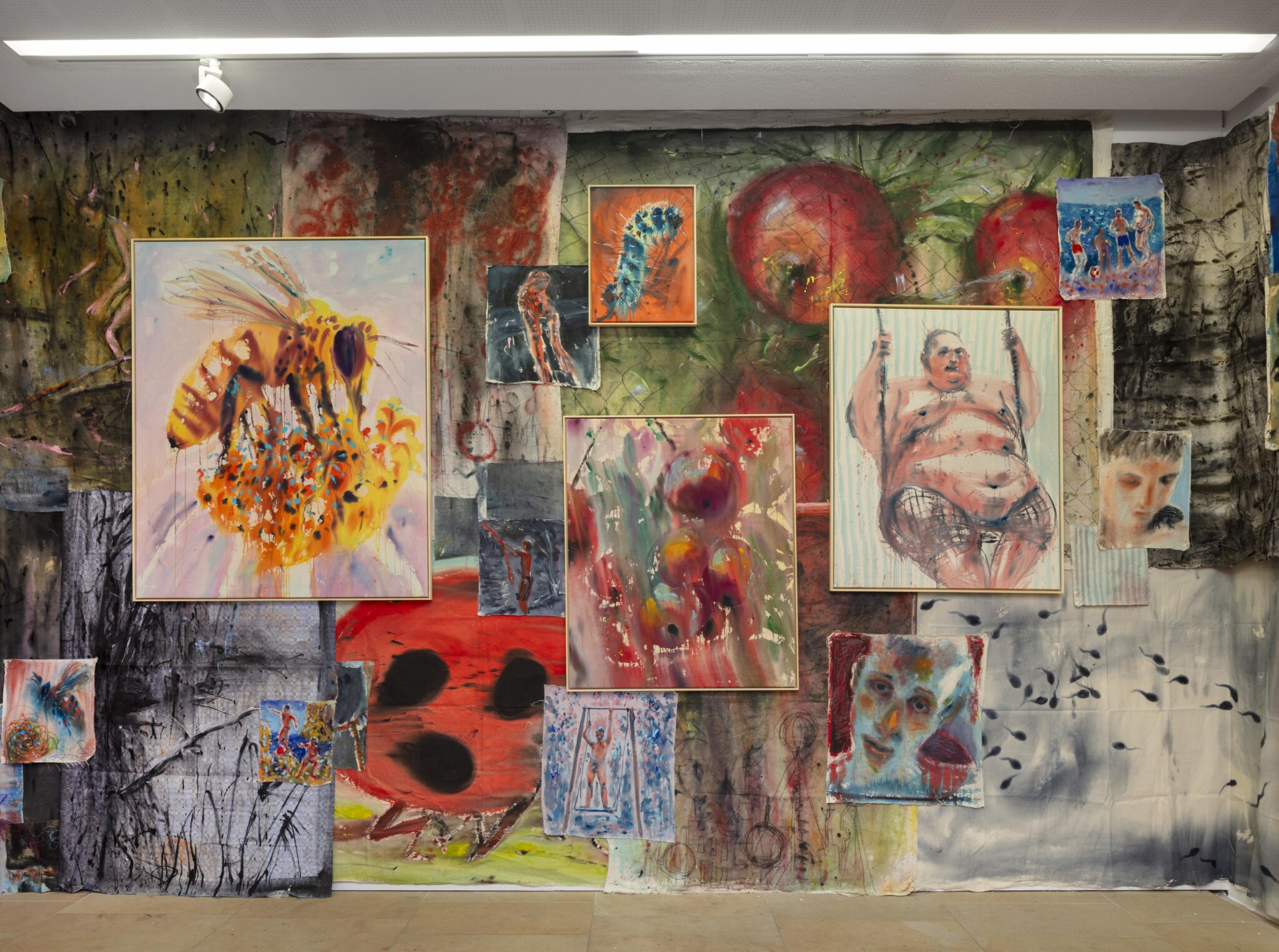
Andrej Dúbravský, installation view of Protest of Peculiars at Kunstpalais, Erlangen, November 29, 2025–February 22, 2026. Photo courtesy of the artist.
CG: Speaking more broadly about your installation techniques, which range from suspended hangings in botanical gardens to paintings scattered across the floor and loosely layered assemblages—as in Protest of Peculiars and Local Philosopher Between Two Summer Storms (FIM Gallery, Seoul, 2025)—your images shift between individual works and fragments of an almost mural-like field, reading as multiple paintings across a single surface. Is this sequencing a preconceived notion that's established while painting, or does it only emerge later in the gallery, and are these works fragments of a larger whole, or do they remain autonomous until they're brought together?
AD: I had this installation idea in my head years before I first tested it in a gallery. I initially felt that it was rude of me to use my own paintings to create a wallpaper effect by nailing some through others, but the experience was very liberating and really fun. It was also great to know that all of this material had some kind of purpose.
The installation technique is 100 percent connected to the way I paint. Because I am using very diluted acrylic paint on raw cotton, there is basically no way I can fix something or repaint it, and I want finished works to feel very light and immediate.
I usually paint more versions of the subject as I explore different colors and shapes, meaning I end up with a lot of canvases that I don’t necessarily want to stretch, frame, or present as finished. The archive of these is slowly growing. It now fits across three large suitcases which I love to travel all over the world with.
I also love that I can create an environment filled to the brim with all kinds of diverse subjects. Some pieces are only a few months old, and others are from as early as 2013. It’s amazing to see all the themes and subjects I was working with over the years. Of course, there are moments where I see a canvas and think that it could have actually been sufficient enough to stretch. Even if it did have multiple holes in it from years of previous nailing… it would be totally ok.
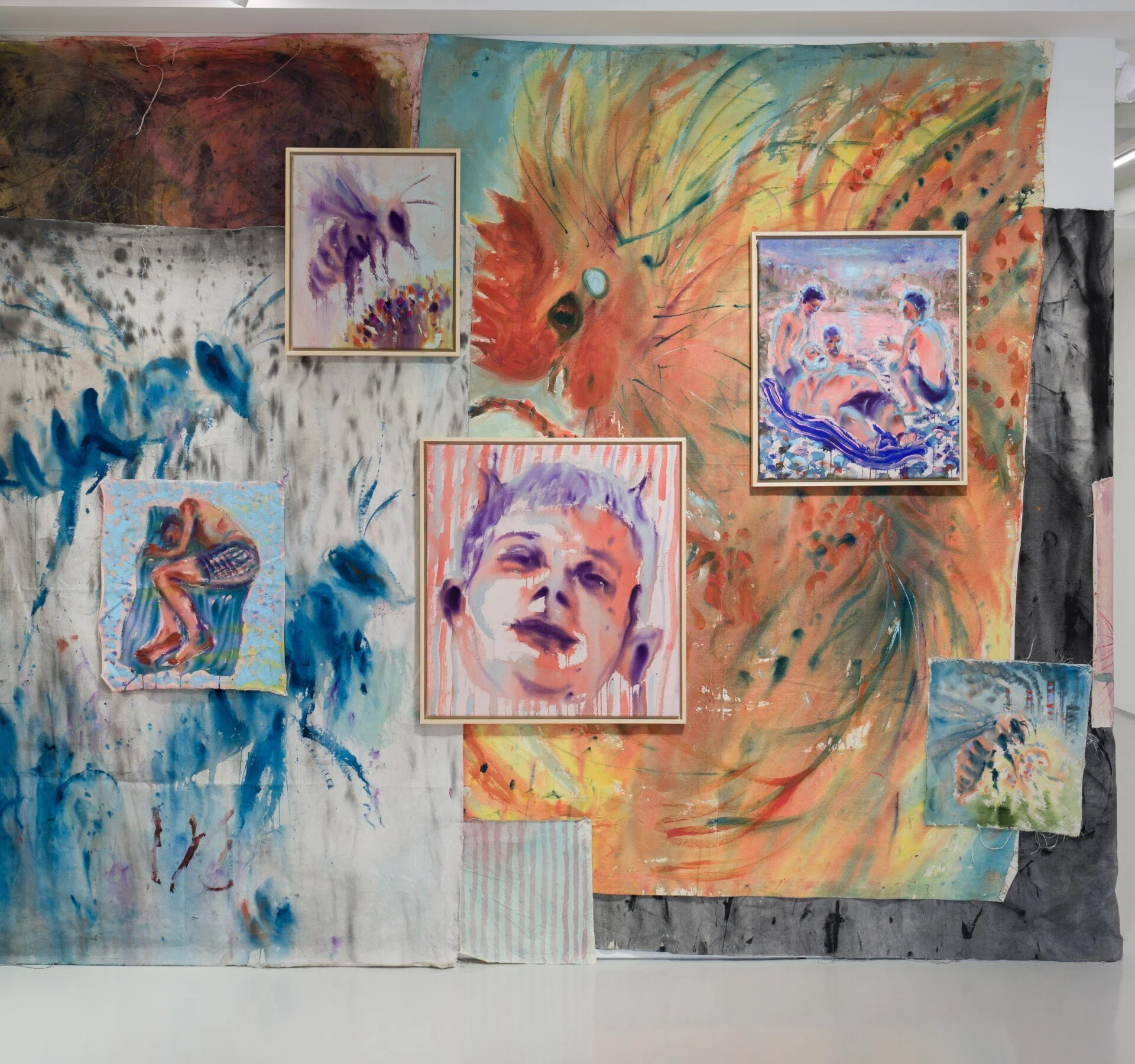
Andrej Dúbravský, installation view of Local Philosopher Between Two Summer Storms at FIM, Seoul, March 13–April 19, 2025. Photo courtesy of the artist.
CG: In Laboratory of Flesh and Balls, held at Gaa Gallery in New York in 2025, you collapsed “flesh” as both a bodily subject and painterly material, while your ideas around “balls” took shape through anatomy and objecthood. You’ve spoken about paint itself as a kind of flesh: thick, resistant, excessive, and almost invasive. How deliberate is this conflation between body and paint? Do you see paint operating as a substitute for the body, as an extension of it, or something that competes against it entirely?
AD: To be honest, I am still processing this series. I gave myself strict limitations while I painted. I stuck to quite small formats, only 100 × 120 cm, and thought strictly about a shoreline, a sky, a ball, and a group of men in movement—that’s it. The whole series was inspired by the boys I observed playing football in Sardinia where, about a year ago, I spent a month mostly drawing and painting. I had a studio in the harbor, and every evening a bunch of teenagers would come to play football right in front of my window. If I kept my lights off, they couldn’t see inside, so I could sketch them and take photos discreetly.
Once I returned home, I turned my football players into some kind of bacchanal ritual, and played a lot with the surfaces of the bodies and the structure of the shore. It involved a large amount of research, and even to this day I regret not creating much bigger paintings on this subject because I think my mid-size canvases can’t really create as much discomfort for my viewers. I also think the bodies I painted were kind of small, but also not small enough. I had so many other thoughts that I understood the moment I arrived in New York and spread the works throughout the gallery. I just knew something was not quite right.
I truly love this series, but think they deserve larger formats in order to create the power, sensuality, and discomfort you mentioned… though there is still potential.
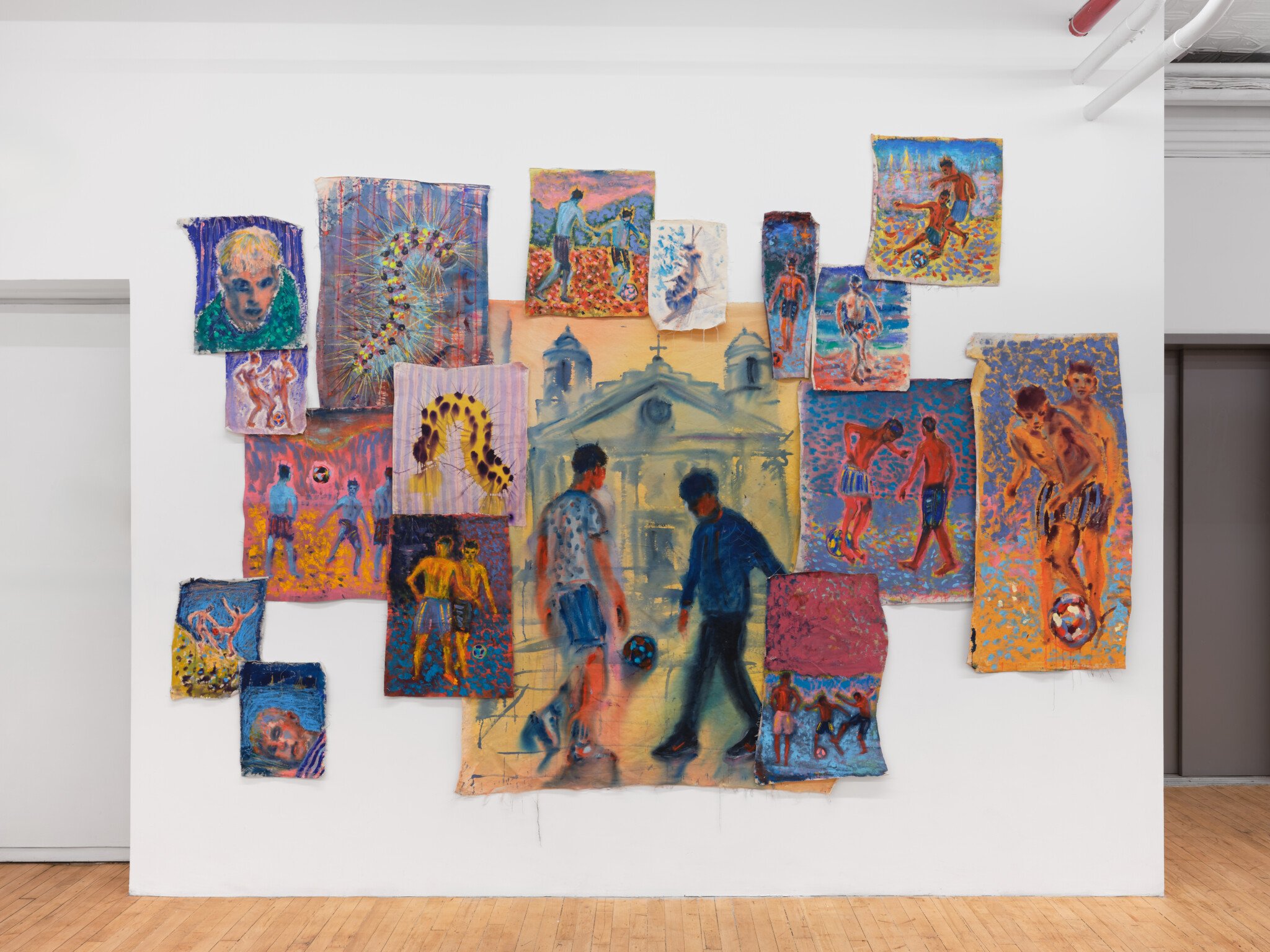
Andrej Dúbravský, installation view of Laboratory of Flesh and Balls at Gaa Gallery, New York, September 5–November 8, 2025. Image courtesy of the artist and Gaa, New York + Cologne. Photo by Matthew Sherman.
CG: The emphasis in these works quickly shifts away from sports, and moves toward bodies in proximity, touch, and choreography. Set against references like Greek athletic ideals, the works seem suspended between innocence, eroticism, mythology, and inherited constructions of masculinity. At the same time, your handling of paint resists stable figuration, and has pushed these bodies toward fragmentation and atmospheric dissolution. How do you navigate the tension between historical archetypes of the male body and contemporary queer experiences, and where does pleasure sit within that?
AD: Ah, contemporary queer experiences… I feel like most audiences nowadays only react strongly to a particular type of queer experience being depicted. I’m not interested in painting the daily life of a queer person taking a shower for example, or doing some cutesy activity in some adorable interior. But in saying that, I totally understand why people, myself included, can connect to these kinds of paintings—the ones full of daily objects like a glass of wine, or toilet paper, etc. As much as I appreciate them, they are not works I want to paint. I actually try to remove everything that’s not essential from the painting, because I want all the drama to happen through the body and face, the surface of the skin, and the painting’s atmospheric background. I don’t want to paint a story, nor use anecdotes about my boyfriends to accessorize them.
I would say that archetypal mysteries excite me the most, and because my own queer experience is complex, dynamic, and forever changing, it would be impossible for me to express it through depictions of “personal” scenes, or daily occurrences.
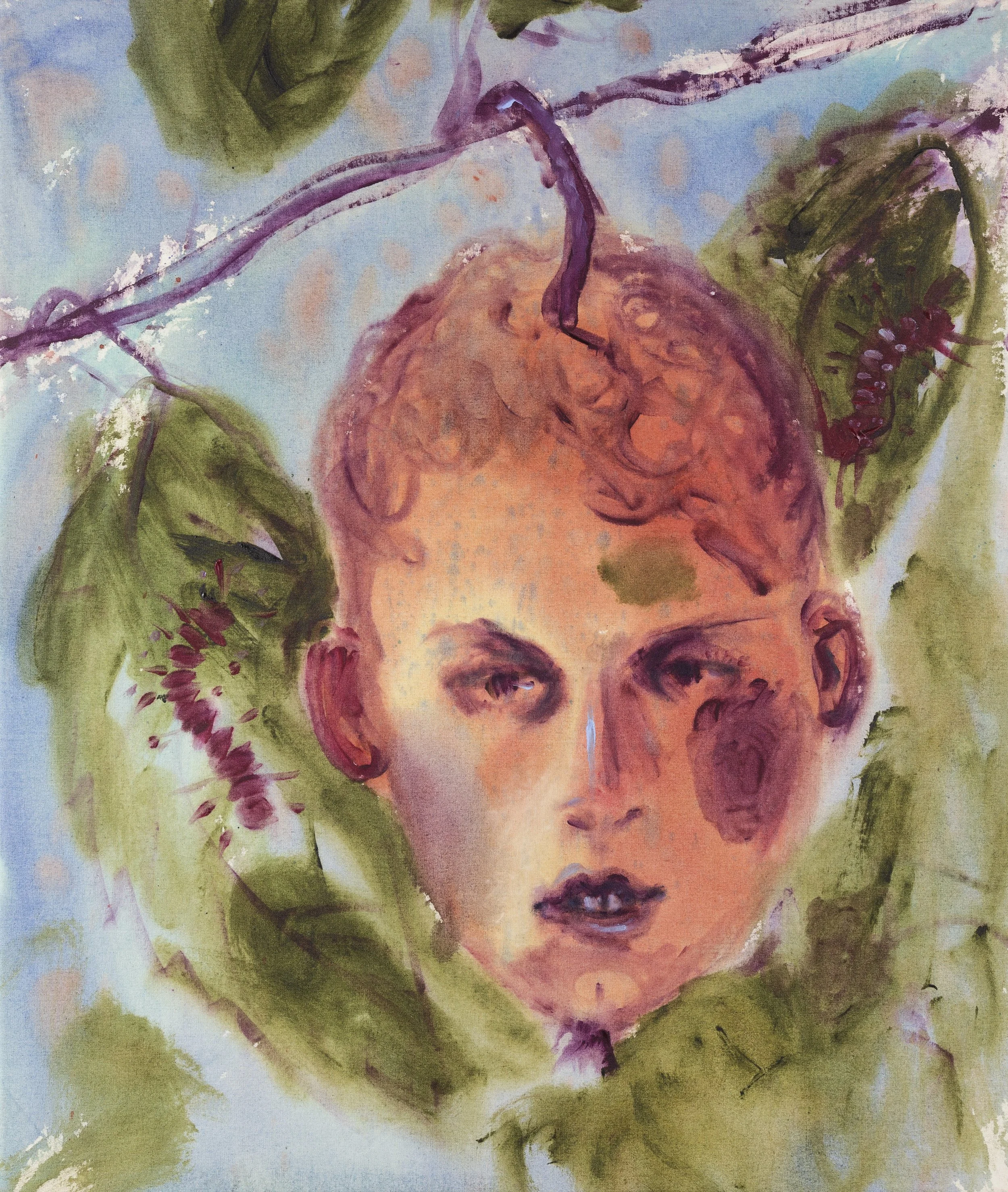
Andrej Dúbravský, Big orange fruit and two caterpillars, 2019. Acrylic on canvas, 95 × 80 cm.
CG: In Anxiety of Subimago at dittrich & schlechtriem in 2023, the idea of the subimago, a winged pre-adult phase in the life cycle of a mayfly, became both metaphor and structure. The exhibition positioned bodies, insects, landscapes, and even discarded studio canvases within a condition of metamorphosis and unresolved becoming. Your figures often seemed caught between emergence and collapse, while the exhibition itself was staged in layers of molted canvases. Do you think your practice fundamentally operates within a condition of incompletion? What draws you to transitional states, whether biological, sexual, ecological, or painterly, and is resolution something you intentionally resist?
AD: For many years at art school with my professors, and later on with curators and gallerists, I experienced people attempting to change me, and to force me to edit out a lot of what I wanted to show. I felt confused, and as though everything I made should appear more organized. I started asking myself questions like “should people only see a few paintings that are entirely finished and polished?” I honestly hated myself for the fact that I wasn’t able to paint in any other manner, or become a different type of artist that was easier to tame. It took a while to understand and finally appreciate that there would be no other case for me. In my work there is always something collapsing, unfinished, missing, or moldy… and my shows are never perfect, nor are the paintings. I feel strange when I see an installation of mine become too balanced. It feels all too serious.
While I constantly feel like a painter subimago, and also one in many other aspects of my life, I am, at least for now, at peace with it.
“In my work there is always something collapsing, unfinished, missing, or moldy… and my shows are never perfect, nor are the paintings. I feel strange when I see an installation of mine become too balanced. It feels all too serious.”
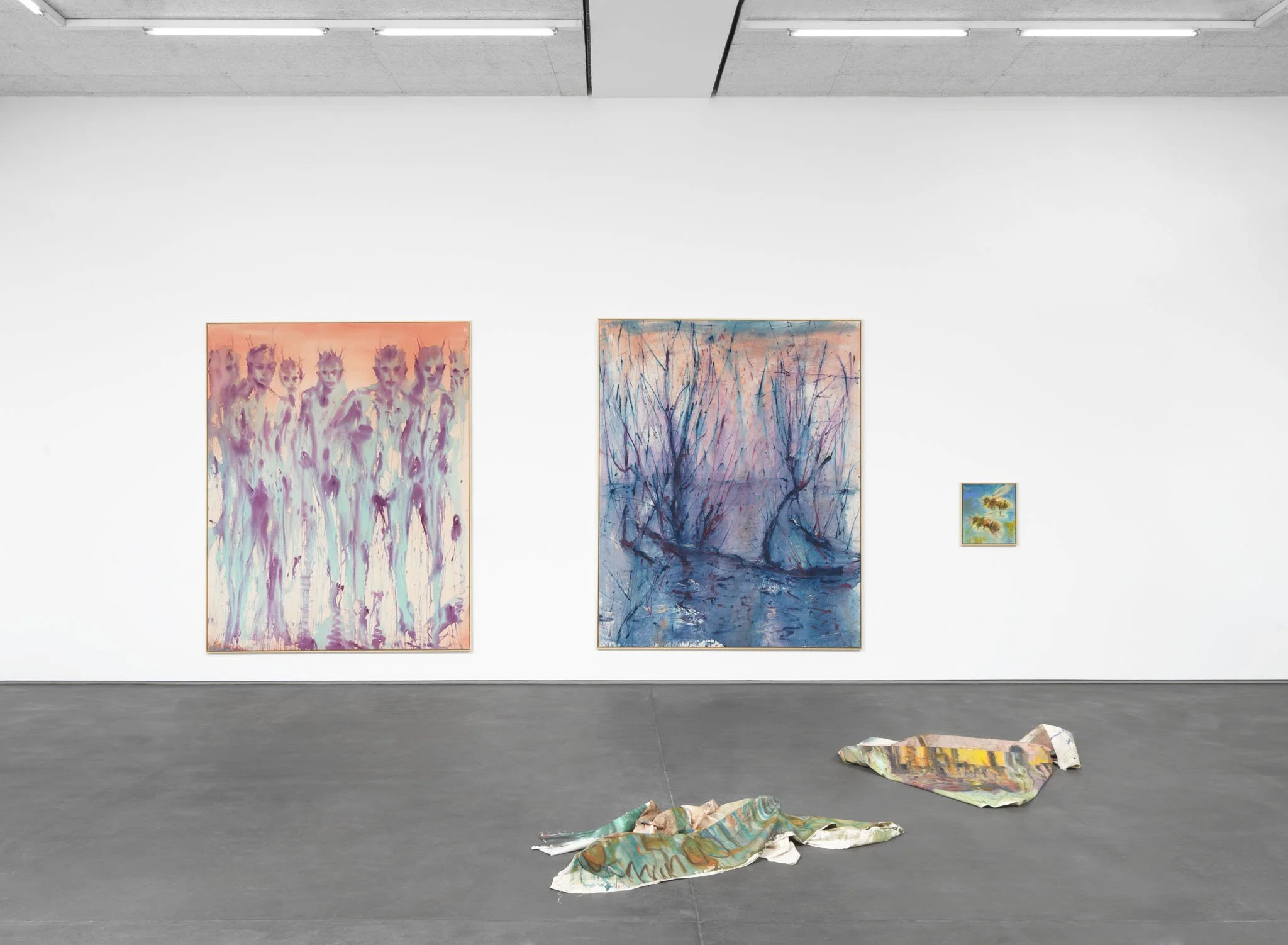
Andrej Dúbravský, installation view of Anxiety of Subimago at dittrich & schlechtriem, Berlin, April 28–July 1, 2023. Photo courtesy of the artist.
CG: The Runners series within Anxiety of Subimago repeatedly returns to fragmented screenshots taken from the same gay pornography video that you chopped apart, isolated, enlarged, and repainted into monumental compositions. Through this process, the source material becomes increasingly estranged from its origin, transformed into something hovering between fantasy, memory, mythology, and abstraction. Claire Koron Elat described these figures as uncertain whether they are “demonic or angelic,” while Nadim Samman noted that your paintings sit on the edge of falling apart formally, held together by an intentionally precarious painterly logic. What interests you about repetition and reworking as a method, and at what point does an appropriated image cease to belong to its source?
AD: I still regret telling people that the images come from porn, as it attracts too much attention, and drags the conversation about these works elsewhere. It was some kind of anniversary video made by a porn production company, where a huge amount of ridiculously good-looking men simply run along a beach. If one were to watch the video in a museum setting, it could totally pass as some kind of contemporary artwork commenting on ideas around “looksmaxing” or the “manosphere,” which fascinated me.
I made many versions of these paintings before they felt right—not too finished, with bodies partially disappearing into the canvas. I tried painting the figures clothed, changing the scale, and adjusting the compositions in subtle ways. Working through variations, and returning to large cycles over the course of several years with this series feels somewhat like field research, though perhaps it is something else entirely. Maybe it’s laziness. Maybe it’s procrastination. Maybe it’s the comfort of returning to something that works within an increasingly stressful and ever-changing world… I am yet to find out.
Andrej Dúbravský (b. 1987 Nové Zámky, Slovakia) graduated from the Academy of Fine Arts and Design in Bratislava, Slovakia, in 2013. His work is represented in the public collections of the Bratislava City Museum and the Slovak National Gallery in Bratislava. Recent exhibitions include solo presentations at Villa Pellé, Prague, Czech Republic; Kunstpalais, Erlangen, Germany; Gaa, New York, USA; Fin, Seoul, South Korea; dittrich & schlechtriem, Berlin, Germany; Galeria Richter Fine Art, Rome, Italy; Galéria Jána Koniarka, Trnava, Slovakia, among others. Dúbravský has been included in group exhibitions at the Slovak National Gallery, Galerie Crone in Vienna, and Longtermhandstand in Budapest, among others. Dúbravský lives and works in Rastislavice, Slovakia.