Abandoning the slop in favour of Stairing

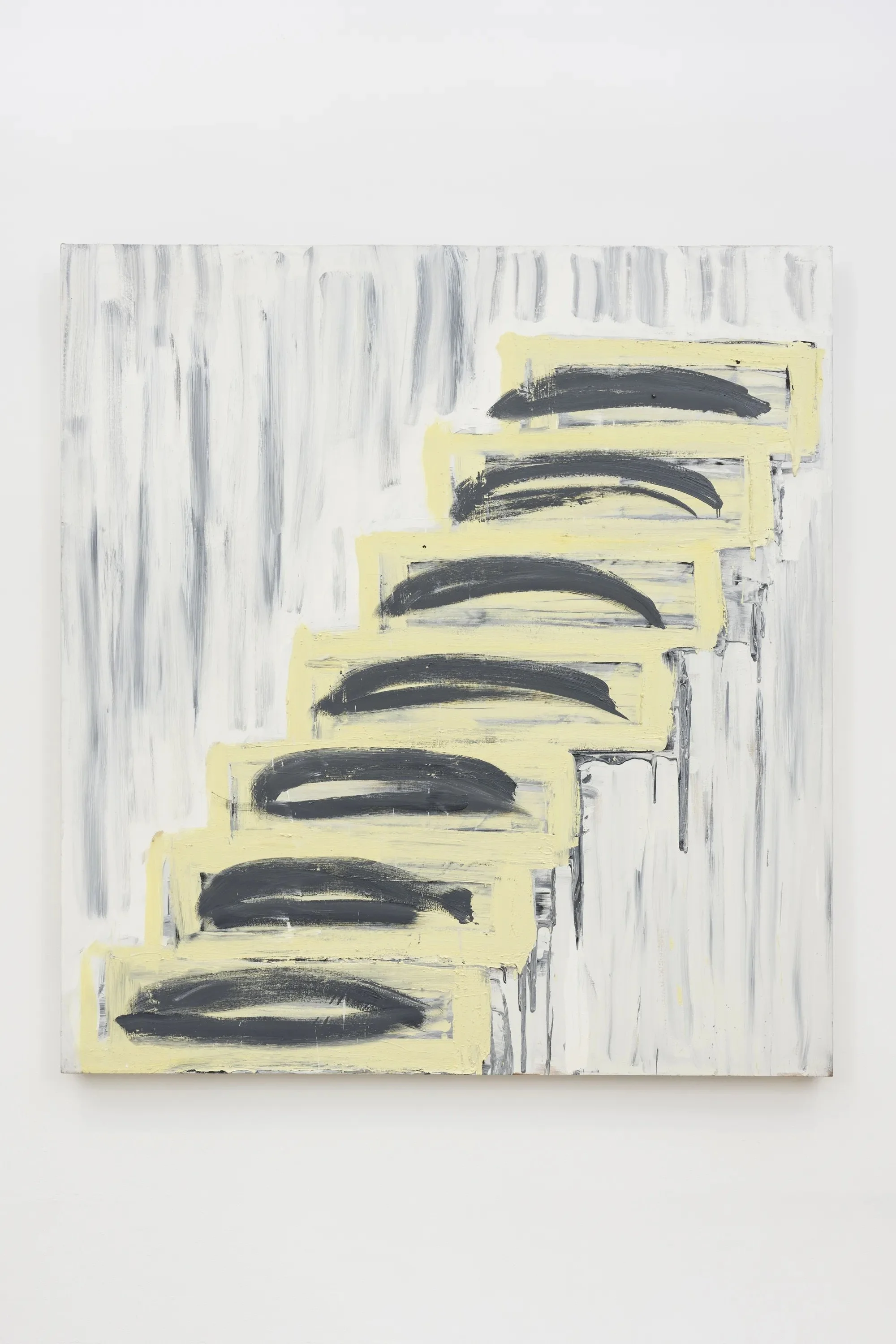
Basil Beattie, Stairing, 2001. Oil and flax, 31.3 × 41.5 × 3.2 cm. Courtesy of the artist and Hales Gallery. Image by Damian Griffiths.
There is a heavy moment around us that cries out for escapism. Knowing so much about that which is happening around us, outside of our immediate bodies and surroundings, comes at a cost to not only mental wellbeing, but how we feel that we fit in the world. It has been widely reported that young people are turning to religion, particularly Catholicism, as an act of seeking hope in a world bound by systems that are inherently hopeless. Research undertaken by law firm Charles Russell Speechlys shows that while 70% of Gen Zs want to get married, this sentiment is only shared by 43% of Millennials. Times of economic depression bring a social pull to conservative values and, ironically, a desperate look towards institutions that had a stranglehold on people for generations. Now that individuals can choose, there is still a sense of holding onto that which we know.
So if escapism is a momentary respite from both personal and wider social issues, and returning to institutional behaviours and systems leaves us at risk of repeating the oppressions of our forefathers, where might we go? Perhaps there is something to be said about how we take up space in the world; being caught in particular poses dictated by our jobs, and reminding our nervous systems that there has to be something beyond what we already think and believe we are capable of. There is a sense that movement in the body and, indeed, the mind could be the key to expanding our horizons. With Big Tech, bloodthirsty world leaders, and shrinking budgets for community and health projects, we have to look beyond what we know. Perhaps we must look entirely in the other direction.
Expanding beyond our own horizons can take many forms. For instance, the 2021 film Don’t Look Up, directed by Adam McKay, sees two scientists spot a meteorite that is rapidly heading towards Earth, with disastrous predicted consequences. In a flimsy metaphor for climate catastrophe and political, media, and Hollywood ignorance over its gravity (its lead actor, Leonardo di Caprio, is a known user of private jets, and was recently exposed as having used one for an 8,000-mile trip to collect an environmental award), both sides of the argument were depicted rather cartoonishly, but not entirely unrealistically: the dedicated, passionate scientists were pragmatic in their recommendations, while the media, particularly Right-leaning outlets, decried a “Woke mob” who scaremonger and prevent people enjoying their lives. The binary motions were looking up and looking away. Both in the film and in our reality, looking up and looking outward into the world around us is always an option. Looking down and into one’s own self-interests, or even our phone, is in cahoots with climate denialism, but is seen as the neglectful, insular option. Filmed prior to the global pandemic, there was another layer of metaphor at play by the time of its release, whereby a thorough, scientifically empirical stance on the virus was being rejected, as many people refused to temporarily sacrifice things they enjoy, instead opting for a mass-disabling medical event that killed thousands of people.
The physicality of our lifestyle (sedentary work, excessive mobile phone use) will keep chiropractors in business until the end of days. In contrast to the addictive spirals of technology use, looking up can evoke a sense of calm, a sense of freedom, a sense of exploring possibilities that could bring one to these utopian ideals.
But “looking up” and seeing each other in times of both need and strength can look a multitude of ways. Aside from its primary market force, the contemporary art world tends to boast of itself as a great form of escapism, but the institutions of museums and galleries reproduce the same behaviours of consumerism, neurotypical social etiquettes, and the same forms of exclusion that they purport to oppose. But in looking at things as systems and not compartmentalising and singling out, we end up missing the bigger picture. Artists Basil Beattie and Tala Madani have used the process of walking up and looking up as a tool for something other than what we know, elevating ourselves from the mess that can be found on the ground. What would happen if we looked up when life became too overwhelming, and we instead followed what we saw, and what we felt in our hearts?
Taking oneself outside of one’s own body is a magical, mystical process that has the potential to be hugely empowering. With an understanding of what, or who, oppresses us as individuals and collectively, looking up at the unknown and the not-yet-known is crucial to our survival in times of severe hardship. Artworks have the potential to provide this small sense of freedom and authentic living that we might be inspired by when “looking up,” partly because of the way that the viewer must position and realign their body when they observe them. Historically, the argument has been that this positioning is to affirm the viewer’s lowliness and to instill a sense of awe towards the godlike vision and genius of the artist, but this is not always the case.
Basil Beattie, Stairing Up, 2000. Oil and wax on canvas, 213.3 × 198.2 × 8.4 cm. Courtesy the artist and Hales Gallery, Photography by Damian Griffiths. Image by Damian Griffiths.
I first experienced Basil Beattie’s painting from 2000, Stairing Up, in a rather crowded group show, full of art that included minute details and small elements of quirky charm that drew the attention of the audience. Anecdotally, on this occasion, Stairing Up was being largely overlooked, despite Beattie’s fame, but I was instantly drawn to it. A flurry of iconography flew through my mind: the stairs leading up to the golden gates in the afterlife; falling off a tall height in an act of suicide; dirt being dragged through the home; a perceived lack of structural integrity in a free-standing staircase; postmodern design devoid of soul and human interaction. While these ideas may seem a touch macabre, the Gothic concept of abandoned domestic spaces is nothing new. Hence, Beattie’s staircase, as the focal point of his painting, demands that the viewer looks up and into this unknown space. We are invited to walk into nothing, but at the same time, walk into everything and anything. Many of us are in utter despair at the world around us, feeling that violence, destruction, and degradation is relentless, as is the avarice that has brought us here as a society.
Beattie’s painting, nestled among others but holding its own distinct space in part due to its domineering scale, gazed back at me, and whispered, “let’s get out of here.” Of course, ascending a staircase is a form of movement, and in its own small way, Stairing Up is showcasing a way out. Meanwhile, the artist’s style employs an earthy, textured paint that makes itself known in its materiality; the viewer does not assume they are looking at a staircase. Stairing Up is certain in its depiction and allusion as opposed to material being, therefore doubling up its power to lead us in a dream or subconscious state. The domesticity of a real staircase is stripped from the symbolism of the staircase, usurped by wonder and dreaming.
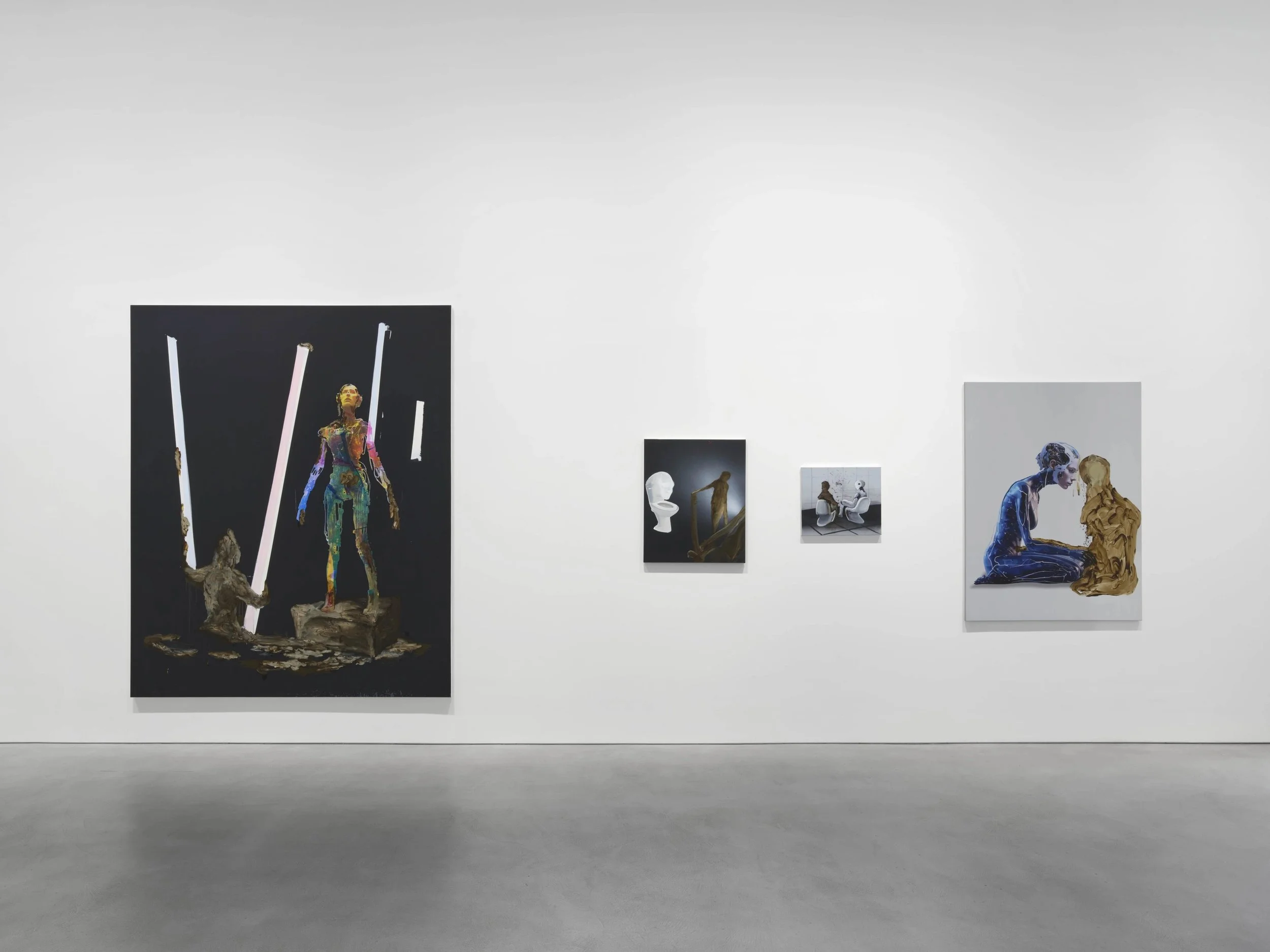
Tala Madani, Daughter B.W.A.S.M, 2026. installation view. Courtesy the artist and Pilar Corrias, London.
“…the act of looking up is also a plea to seek respite from the world, but with the additional acknowledgment that her work will only continue up the stairs. Rest is only ever temporary.”
A different kind of escape is demonstrated in the recent work of Los Angeles-based artist Tala Madani, whose series Shit Mom comprises painting and video pertaining to the hyper-mundaneity of child-rearing. Taking the name to its most literal meaning, the motif of the body of work is essentially a shape-shifting, anthropomorphised faecal smear sullying one pristine home after another. Said figure is invariably a mother who is greatly fatigued at an unceasing litany of household chores. For Madani, or at least for the nameless figure she conveys in her work, the act of looking up is also a plea to seek respite from the world, but with the additional acknowledgment that her work will only continue up the stairs. Rest is only ever temporary.
Madani’s latest body of work shows Shit Mom (the character) joined by an AI Daughter, and the two figures engage in a visual dialogue that sees the tête-à-tête between sterile perfection and squalor. To paraphrase the now-familiar adage, if we really must have AI living among us, can we put it to work taking on mind-numbing household chores instead of tech bros making art, design, and knowledge (re)production its destructive raison d’être?
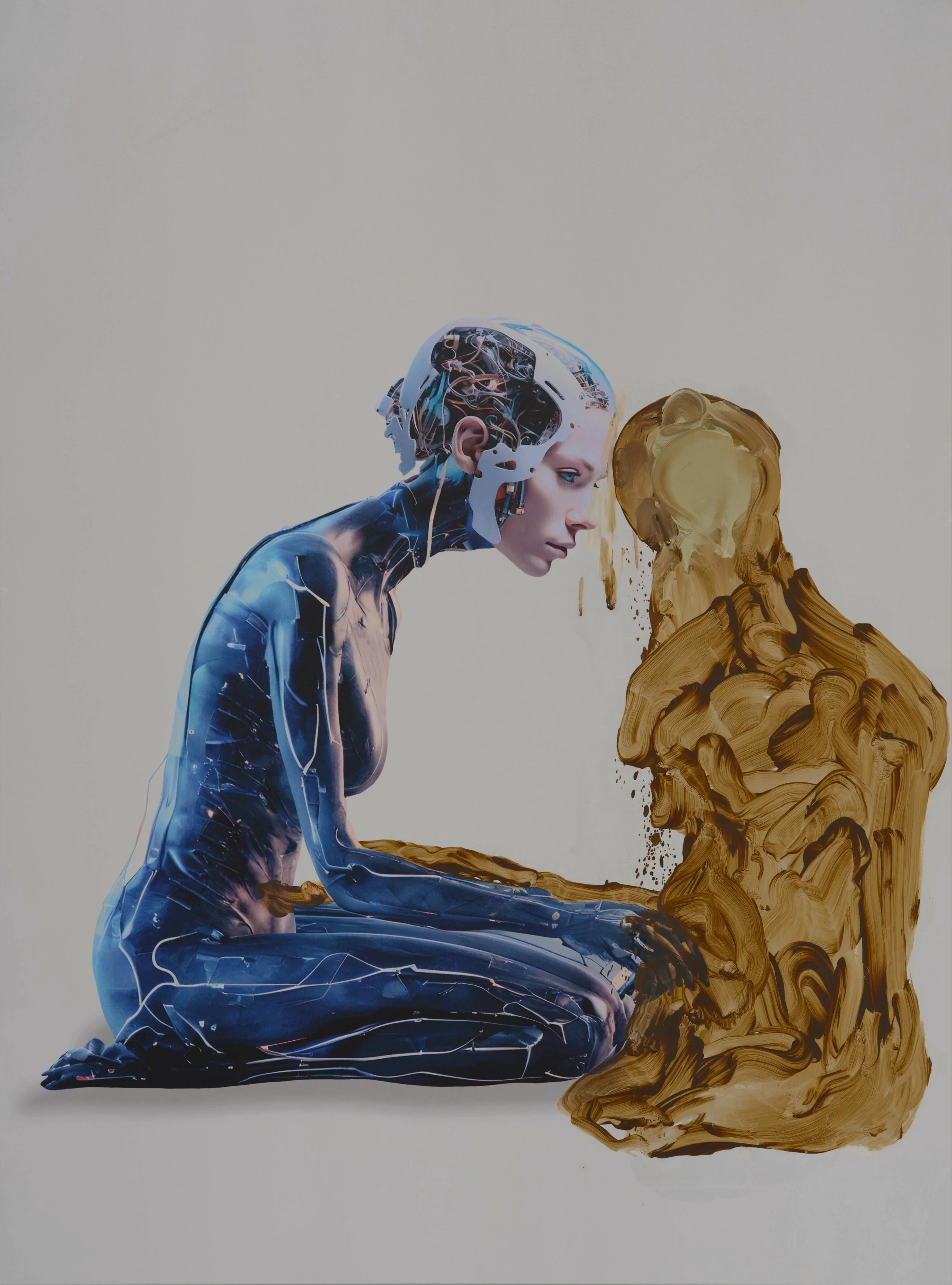
Tala Madani, D.B.W.A.S.M. (Umbilical Discord), 2025. Oil and ink on synthetic polymer, 152.4 × 114.3 × 2.5 cm. Courtesy of the artist and Pilar Corrias.
Shit Mom is visibly exhausted in Madani’s work, but there is a certain tenderness in the filthy devotion, as opposed to the immaculate but inhuman positioning of the AI daughter. Shit Mom Ascending a Staircase adopts the artist’s exquisitely hyperreal painting abilities with the now-recognisable marks of our protagonist sloping upwards, taking distinctly human steps but leaving filth in her wake. Whereas with Stairing Up we crane our necks towards an unknown space, Shit Mom Ascending a Staircase muddies the assumption that there is something beyond ourselves as a human body in this singular moment. The allusion to Marcel Duchamp’s infamous Nude Descending a Staircase (No.2) is a smart and endearing one, playing again with the rejection of social mores that were a concern over a century prior, while posing the question of gendered labour and motherhood, both of which are of little concern to the art world writ large.
How might Duchamp’s figure move in the world today, and what commentary might it bring with it? Whereas Duchamp was concerned with abstraction and High Art as opposed to that which is easily recognisable and palatable, Madani takes us straight back to what the viewer knows and understands. The puerile humour may not be to everyone’s taste, but bringing the quotidian back into the institutional art gallery opens the door to more of us, and tells us that we may not need to look up and out from our lives, instead forming community and understanding with one another.
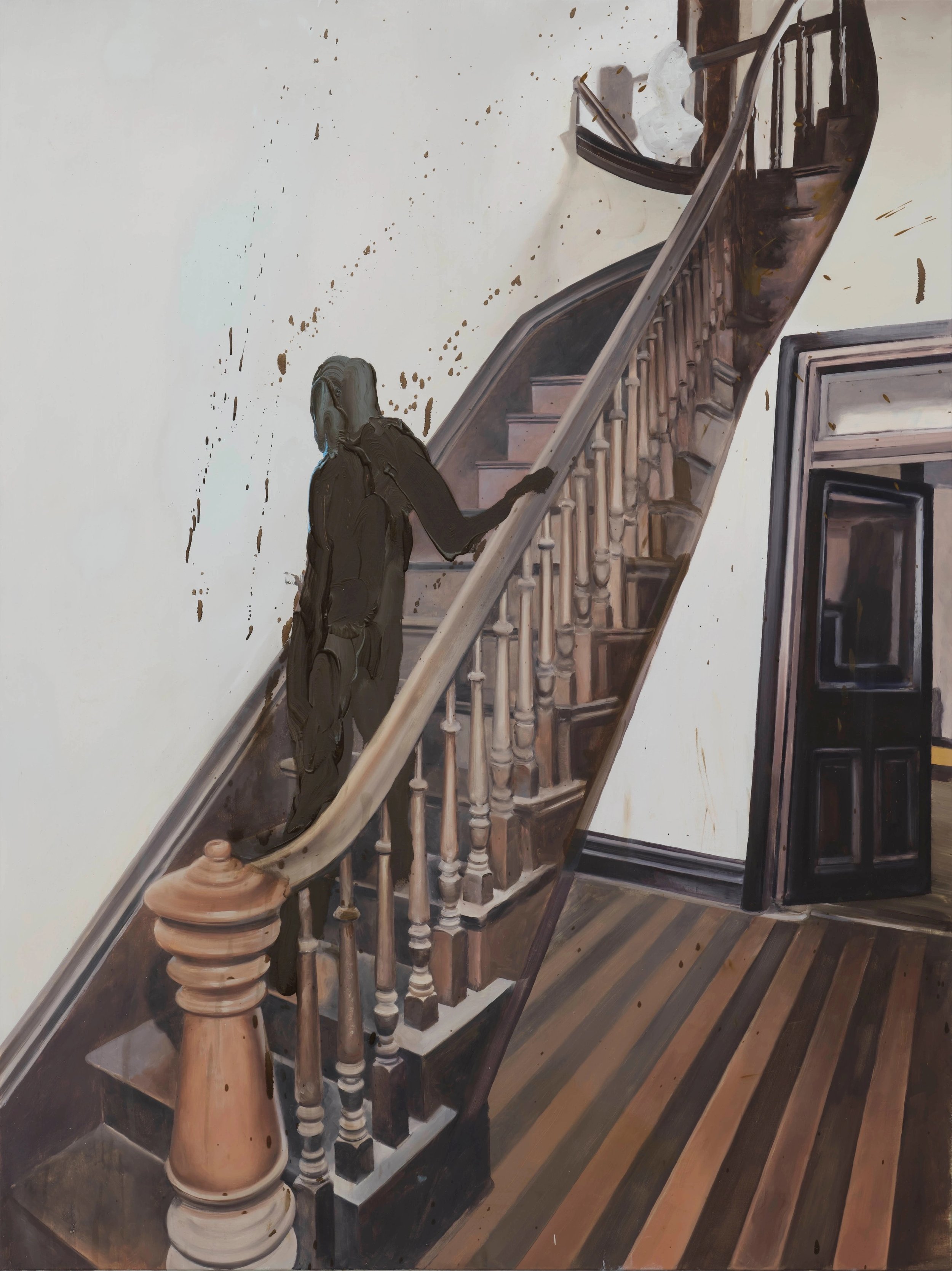
Tala Madani, Shit Mom Ascending a Staircase, 2025. Oil on linen, 121.9 × 91.4 × 3.2 cm. Courtesy of the artist and Pilar Corrias.
Looking up and moving towards the unknown is not something that comes naturally to the human psyche. Being asked to raise our heads above the parapet takes noble bravery, whether on a micro or macro scale. In reality, every significant change takes small actions in a positive direction and this is mirrored in the works of Madani and Beattie. Whereas Beattie is quicker to announce a possibility of myriad directions and infinite endings, Madani’s work rooted in domestic and gendered labour provides a reality check; the institutions and systems that have shaped our lives for millennia still call us home. While Shit Mom sprinkles a degree of whimsy to her life and her audience, the artist casts no aspersions about the lived realities that are shaped by domesticity.
Don’t Look Up reminds us that collective action is required for change, but with the perceived safety of our normative behaviours combined with the overwhelm of the “permacrisis” era we are swiftly reminded that the individual action and community that are so sorely needed remain out of reach in consumerist society. Anxiety, after all, is not the great bringer of change that we might expect.
Blurring the distinction between individual and collective action, both Beattie and Madani show us that new directions and new movements can be hopeful. In asking their respective viewers to look up and follow what they find, both Beattie and Madani speak to a gaping chasm of care in the world we live in. We do not have the luxury of looking up and lingering, but we can envisage precisely what we need from a better world, and move up into it. We can make the first step ourselves, and hold out our hands for others to follow suit into a collective vision of respect, safety, and justice.